


How can shoe cabinet storage functions be combined with rotating and pull-out structures to improve space utilization?
Release Time : 2026-04-13
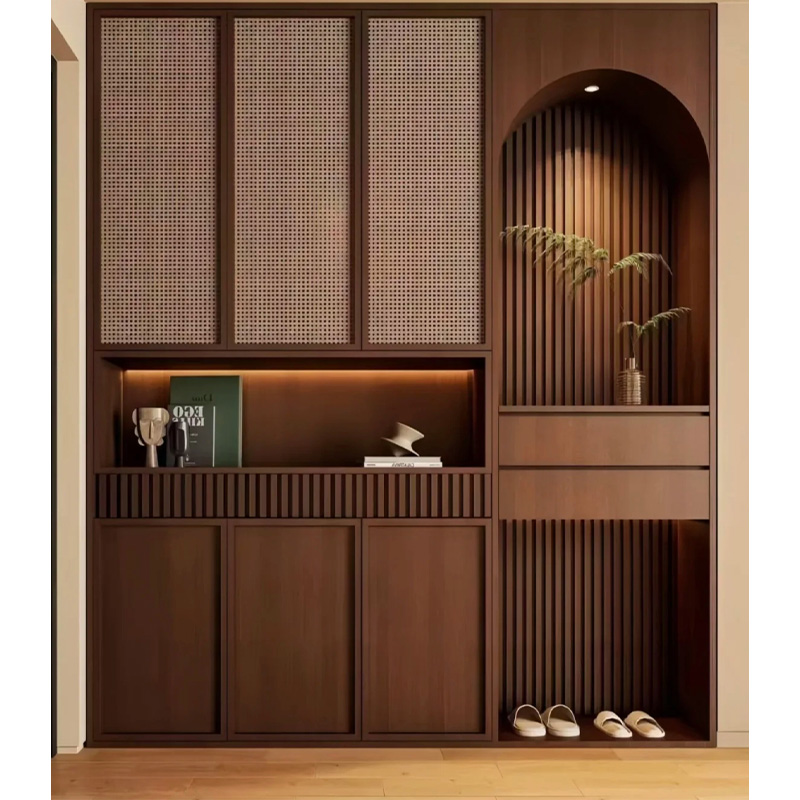
As a frequently used storage piece in the home, the space utilization of a shoe cabinet directly impacts daily convenience and home tidiness. Traditional shoe cabinets often use fixed shelves, which, while meeting basic storage needs, often lead to wasted space due to their simple structure when dealing with different shoe types, seasonal footwear, and special items (such as shoe boxes and umbrellas). By introducing dynamic structures such as rotating and pull-out drawers, the static limitations of traditional shoe cabinets can be overcome, enabling multi-dimensional space utilization and functional expansion.
The core advantage of rotating structures lies in transforming planar space into three-dimensional storage through circular motion. For example, a rotating column can be installed inside the shoe cabinet, with adjustable shoe racks installed in layers. Rotation exposes different layers of racks sequentially, avoiding the difficulty of retrieving items due to the depth of traditional shelves and expanding the space that could only hold one row of shoes into multiple rows of three-dimensional storage. This design is particularly suitable for storing boots or high-top shoes; by adjusting the angle and spacing of the racks, shoes can be stored securely without taking up extra space. Furthermore, rotating structures can be integrated with lighting systems to automatically illuminate the current shelf when retrieving items, further enhancing the user experience.
Pull-out structures, on the other hand, utilize linear sliding to maximize space utilization. Traditional shoe cabinets often have fixed shelves that are too deep, making it difficult to access shoes further inside. Pull-out shelves, however, can be fully extended, making the contents readily visible. For example, the bottom of the shoe cabinet can be designed as a pull-out flat shoe storage area, with non-slip material on the shelf surface. Shoes move synchronously with the shelves during the pull-out process, preventing them from scattering. The top can be combined with a pull-out shoebox rack for storing seasonal or rare shoes, implementing a "first-in, first-out" storage logic through the pull-out operation, reducing rummaging time. Additionally, pull-out structures can be applied to the sides or corners of shoe cabinets, transforming previously unusable irregular spaces into pull-out umbrella racks or accessory drawers, improving overall space utilization.
The combined application of rotating and pull-out structures can further amplify the space optimization effect. For example, a rotating shoe rack in the center of the shoe cabinet stores frequently used shoes, surrounded by pull-out storage compartments for shoe polish, brushes, and other care tools. The bottom features a pull-out flat shoe rack to meet daily shoe-changing needs. This layered design ensures easy access to frequently used items while concealing less frequently used items within the dynamic structure, creating a gradient distribution of "active-semi-active-static" space within the shoe cabinet. This aligns with usage habits and avoids wasted space.
The introduction of the dynamic structure also requires consideration of structural stability and safety. The rotating columns must use high-strength bearings and reinforced bases to ensure stable rotation even when carrying multiple pairs of shoes. Pull-out shelves must be equipped with damping rails to prevent items from tipping over or damaging the cabinet due to rapid pulling. Furthermore, the edges of the dynamic structure must be rounded to prevent bumps and injuries during daily use, especially important for families with children.
The design of the dynamic shoe cabinet must also coordinate with the overall home décor. Rotating metal columns can be paired with wooden or glass shoe racks to create a modern minimalist style; pull-out panels can be chosen in the same color family as the cabinet or in a contrasting color to enhance the three-dimensionality of the space through color layering. For example, embedding light-colored pull-out shelves into a dark cabinet highlights the presence of the dynamic structure while avoiding visual oppression; while the transparent shoebox design of the rotating shoe rack allows the shoes inside to become decorative elements in the entryway, achieving a unity of function and aesthetics.
Through the innovative application of dynamic structures such as rotating and pull-out mechanisms, the shoe cabinet is no longer just a container for shoes, but a key element in improving home efficiency and quality. Its core value lies in using "dynamics" to overcome the limitations of "static" space, replacing "single" storage logic with "multi-dimensionality," and ultimately achieving great use in small spaces.